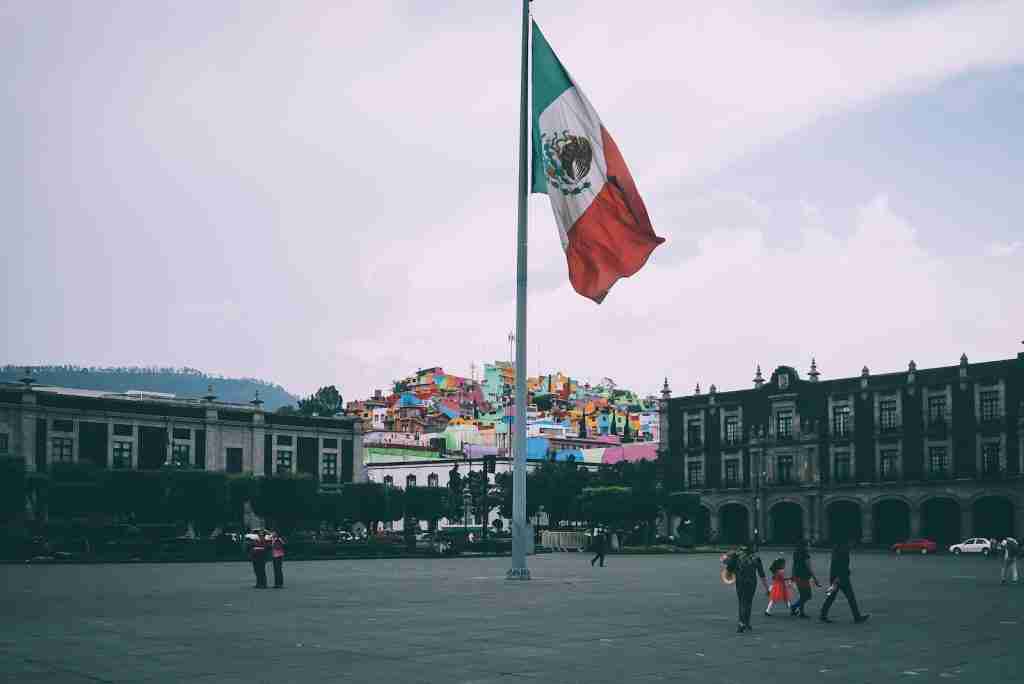
Mexico City is sinking — by as much as 50 cm a year in places — because it was built on a drained lake. The Aztec capital Tenochtitlan sat on an island in Lake Texcoco; the Spanish drained it, and the modern city has been settling into the soft lakebed ever since. Buildings visibly tilt, and the Metropolitan Cathedral has needed decades of engineering to stop it twisting apart.
That one fact explains more about Mexico than any list of statistics: it is a country built directly on top of an older one. Below, the facts are grouped by what they tell you — the land, the history still visible in daily life, and what Mexico gave the rest of the world. There is also a section on the things people believe about Mexico that are simply wrong, starting with the most common one.
What Mexico gave the world
A remarkable share of the global pantry originated here.
- Chocolate, chilli, tomatoes, vanilla, avocados and corn all come from Mesoamerica. Before contact with the Americas, no Italian cooked with tomatoes and no Indian dish used chilli — both arrived after 1492.
- Chocolate was originally a drink, and bitter. The Aztecs drank it unsweetened and spiced, and cacao beans were valuable enough to be used as currency.
- Mexico is the world’s largest producer of silver, and has been a major source for centuries — silver from Mexican mines circulated as far as China.
The land itself
- A volcano was born in a cornfield. In 1943 a farmer near Parícutin watched a fissure open in his field. Within a year the volcano was over 300 m tall. It buried two villages and is one of the few volcanoes whose entire life cycle has been observed.
- Mexico has the second-longest peninsula in the world — Baja California, running roughly 1,250 km.
- The Mesoamerican Barrier Reef, running along the Yucatán coast, is the second-largest reef system on Earth after Australia’s.
- Popocatépetl, beside Mexico City, is active and has erupted repeatedly in recent decades. Millions of people live within sight of it.
History you can still stand in
- Mexico has 35 UNESCO World Heritage sites — more than any other country in the Americas.
- Chichén Itzá’s main pyramid answers you. Clap at the base of El Castillo and the echo returns as a chirp resembling the call of the quetzal, a bird the Maya held sacred. Acoustics researchers regard the effect as deliberate.
- Day of the Dead is recognised by UNESCO as intangible cultural heritage. It is not a Mexican Halloween — it is a family observance of remembrance, and it predates the Spanish arrival.
- The flag records a founding legend. The eagle on a cactus devouring a serpent is the sign the Mexica were told to look for when choosing where to build their city. They found it on an island in Lake Texcoco.
Language and people
- Mexico recognises 68 indigenous languages, with hundreds of variants between them. Náhuatl, the Aztec language, still has well over a million speakers.
- English borrowed more from Náhuatl than most people realise — chocolate, tomato, avocado, coyote and chilli all trace back to it.
- Mexico is the most populous Spanish-speaking country in the world, with more Spanish speakers than Spain.
Four things people get wrong about Mexico
- “Cinco de Mayo is Mexican independence day.” It is not. Independence is celebrated on 16 September. Cinco de Mayo marks the 1862 Battle of Puebla and is a relatively minor holiday in most of Mexico — it is observed far more widely in the United States.
- “Tequila is made from cactus.” It is made from blue agave, which is not a cactus — agaves are more closely related to asparagus.
- “Everyone speaks only Spanish.” Spanish is dominant, but 68 indigenous languages are officially recognised and millions speak one.
- “Mexican food means burritos and nachos.” Both are largely northern-border or American inventions. Traditional Mexican cuisine is itself on UNESCO’s heritage list, and varies enormously by region.
Frequently asked questions about Mexico
Why is Mexico City sinking?
It was built on the bed of a drained lake, and groundwater extraction has compacted the soft clay beneath it. Parts of the city have dropped several metres over the last century, and the rate in some districts still approaches 50 cm a year.
Is Cinco de Mayo Mexico’s independence day?
No. Mexican independence is 16 September. Cinco de Mayo commemorates a single victory at the Battle of Puebla in 1862 and is a much bigger occasion in the United States than in most of Mexico.
What foods originated in Mexico?
Chocolate, corn, tomatoes, chilli peppers, vanilla, avocado, beans and turkey among others. Much of what the world considers Italian, Indian or Thai cooking depends on ingredients that came from Mexico after 1492.
How many indigenous languages are spoken in Mexico?
Sixty-eight are officially recognised, with several hundred regional variants. Náhuatl has the most speakers, well over a million.